Applying J-Space to OthelloGPT
‼️ Below my commentary is a lightly edited LLM-generated draft, which should be read as such. These are preliminary results, more work ongoing.
Commentary
After seeing a talk on the J-Space method at ICML2026, I thought a good way to get situated on the method would be applying it to a small model and seeing what that J-Space looked like. The idea here was to get at 2 different questions I had right away:
- What does the J-Space look like in non-language settings?
- What does the J-Space look like in very small models?
The J-Space method applied to OthelloGPT yields fairly obvious results. It is highly predictive of valid next moves, and weakly predictive of player-turn and board state. Additionally, steering can guide towards chosen valid moves. However, I think the effect is “weak” here in the sense that predicting next moves is the trained function of the model, so the notion of “a workspace” for planning doesn’t make as much sense here.
AI edited text begins below, I still need to polish it.
Summary
We used a Jacobian lens to ask whether a tiny Othello-playing transformer develops a shared internal representation for selecting legal moves. The results point to a clear late-stage action subspace: by the final layers, move information is readable, targeted directions can causally promote particular moves, and removing the move-aligned subspace severely damages play.
Code at github.
This is encouraging evidence for a minimal workspace-like mechanism. It is not yet evidence for a fully general workspace: the effect is concentrated near the output, overlaps strongly with the ordinary logit readout, and occupies a substantial fraction of the final residual stream.
1. Legal moves become directly readable
The Jacobian lens was fit on 100 Othello games and evaluated on a separate 100 games. Its ability to identify the sampled next move rose steadily through the network: pass@5 increased from 0.181 at layer 0 to 0.610 at layer 6, essentially matching the model’s final logits at 0.613.
More importantly, the lens increasingly represented the set of legal actions, not just the sampled target. Legal precision among its top five moves rose from 0.265 to 0.921, while total probability assigned to legal moves rose from 0.220 to 0.994.
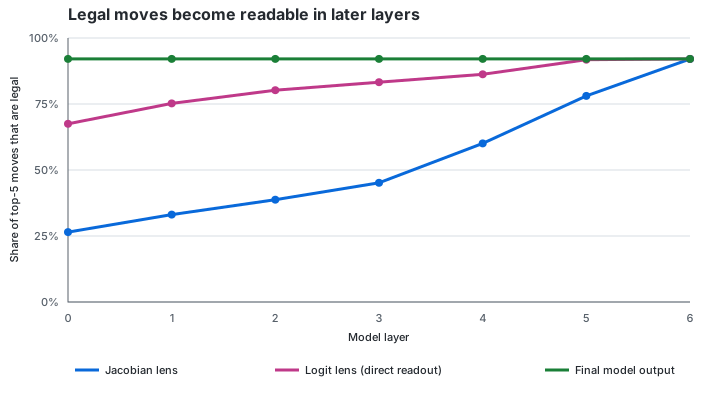
The ordinary logit lens is stronger in the early layers. The Jacobian lens catches up only near the end, suggesting that the network gradually transforms its internal state into an action-ready representation.
2. Move directions are causally writable
We next added small, norm-scaled interventions pointing toward selected move directions. At layer 6, writing the target move’s Jacobian direction increased its final logit by 0.239, compared with -0.016 for a matched random direction and 0.031 for another move’s Jacobian direction. The target improved by an average of 4.4 rank positions.
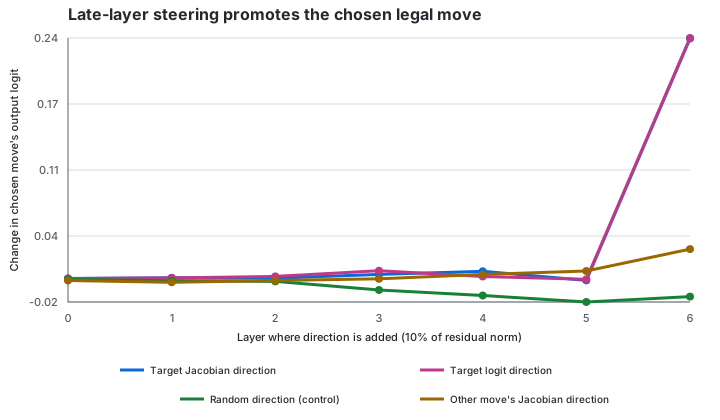
The causal effect is highly concentrated at layer 6, where Jacobian and ordinary logit directions behave almost identically. This supports a real action-writing interface, but currently looks more like a final action bottleneck than a workspace operating throughout the model.
Steering toward illegal moves raised their logits but almost never put them in the top five. The representation is therefore writable, while the surrounding computation continues to enforce strong legality constraints.
3. The action subspace is functionally privileged
At layer 6, the 60-dimensional linear span of move directions contains essentially all linearly probed legal-action information:
| Representation | Legal precision@5 | Next-move pass@5 | Board-state accuracy |
|---|---|---|---|
| Full residual stream | 0.916 | 0.426 | 0.369 |
| Move/Jacobian span | 0.916 | 0.588 | 0.346 |
| Orthogonal component | 0.606 | 0.231 | 0.371 |
The complementary component retains slightly more board-state information and nearly all player-identity information. This is the expected qualitative split between an action-facing representation and richer internal state, although the board probe is weak enough that this part should be treated as preliminary.
The causal ablation is much clearer:
| Intervention at layer 6 | Legal probability mass | Legal precision@5 | Mean target rank |
|---|---|---|---|
| Baseline | 0.998 | 0.915 | 5.2 |
| Remove move/Jacobian span | 0.284 | 0.337 | 22.1 |
| Remove ordinary logit span | 0.376 | 0.480 | 17.2 |
| Remove matched random span | 0.997 | 0.914 | 5.2 |
| Keep only move/Jacobian span | 0.839 | 0.865 | 7.7 |
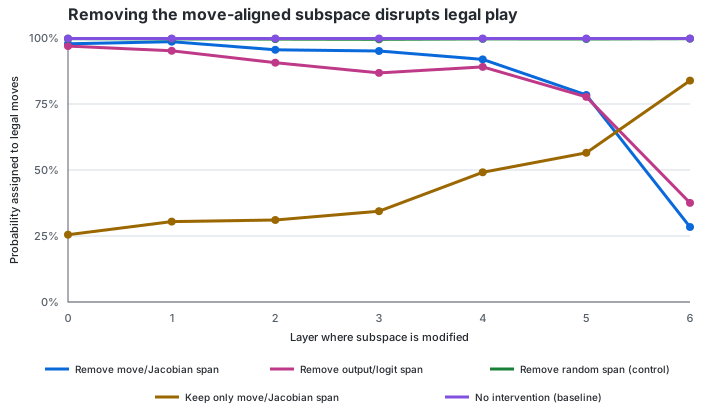
Removing the move-aligned span is catastrophic, while removing a random span of the same size has almost no effect. Conversely, retaining only the move span preserves surprisingly strong legal play. This is the strongest evidence that the subspace is functionally special rather than merely decodable.
Interpretation
The most defensible conclusion is:
OthelloGPT develops a late, causally writable, output-aligned action subspace that concentrates legal-move and next-action information while leaving more detailed state information outside it.
This satisfies a minimal workspace idea: information is gathered into a shared format that can be read and causally manipulated to control behavior. The stronger “general workspace” claim remains open. The span has rank 60 of 512, captures 59% of activation variance at layer 6, and closely resembles the output/logit space. It may therefore be a specialized motor or action bottleneck rather than a general-purpose broadcast medium.